Strategy Hub

Stealth Mastery Guide for Paint Hide & Seek

Refine your stealth game with arena-specific tactics, camouflage tricks, and team plays tailored to Paint Hide & Seek. Every section below turns chaotic paint splatters into calculated cover.

Editor's Choice: Best Casual Stealth Game

Outsmart every seeker with tournament-ready stealth routes.

These strategies are designed for players who already know the basics and want to survive tighter arenas, unpredictable AI, and paint-chaos endgames.

Average survival boost
+32% in late rounds
Recommended for
Level 6+ Hiders
Game mode focus
Solo & Team Stealth

Core Playbook

Top Stealth Tips for Paint Hide & Seek

Advanced stealth strategies to outsmart seekers and stay hidden even as paint chaos turns arenas into neon mazes.

1. Play the minimap, not just the corner

Good hiders use corners; great hiders anticipate routes. Treat every arena as a loop of predictable patrol paths. Note spawn points, open sightlines, and dead ends on your first run, then build loop routes that keep you one junction ahead of seekers.

  • Always keep at least two escape paths in your peripheral vision.
  • Avoid hiding in tiles with only one exit unless your power-ups are ready.
  • Rotate between quadrants every 10–15 seconds in early rounds.

2. Think in sound bubbles

Every sprint, slide, and hard turn creates a "sound bubble" that seekers can react to, even if they do not see you. Chain short movements between ambient sound sources like paint explosions and power-up pops to hide your noise.

3. Reserve risk for the final sweep

Early rounds reward patience; late rounds reward bold repositioning. Save your riskiest cross-map dashes for the final 20–25% of the timer when seekers start hard-clearing known hiding lanes.

  • In the opening 30 seconds, prioritize information over distance.
  • Mid-round, shadow the outer edges of seeker patrols to track their habits.
  • In the final sweep, cut diagonally across their predicted return path.

4. Desync your movement rhythm

Seekers unconsciously read patterns. Break your rhythm with off-beat pauses, half dashes, and sudden reversals to stay unexpected, especially in narrow corridors.
Color Arenas

Choosing the Best Hiding Spots

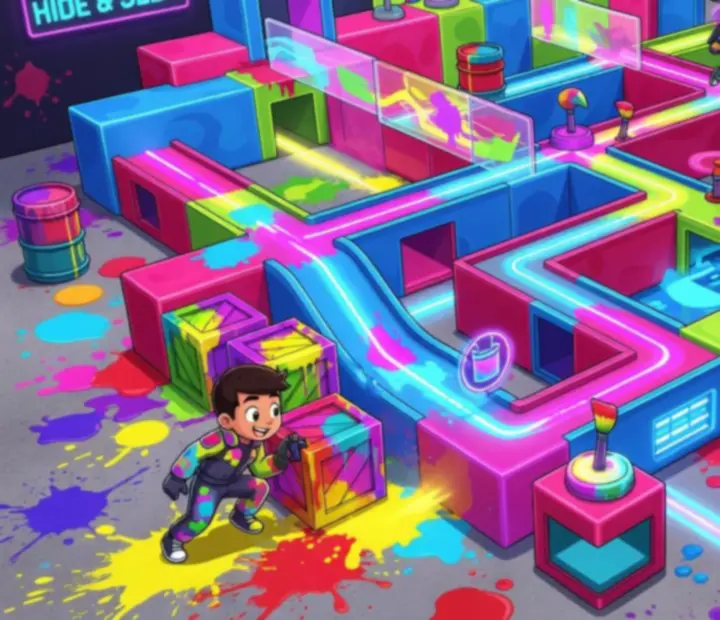
Identify high-value hiding locations by reading geometry, paint coverage, and seeker entry angles in each Color Arena.

Layered corners, not dead ends

Strong hiding spots are corners with offset cover, like stacked crates or paint barrels, that let you line-of-sight seekers without trapping yourself. You want a 90° turn plus a second micro-cover object.

  • Hug cover that breaks vision twice within a few tiles.
  • Avoid true dead ends unless you have invisibility primed.
  • Use L-shaped rooms to pivot behind seekers as they enter.

High-traffic intersections as decoys

Intersections are bad for hiding long-term, but perfect for setting illusions. Splash paint, fake a route, then cut into a side-pocket hideout while seekers chase your trail through the central cross.

Pair these with distraction techniques to turn predictable crossroads into misdirection hubs.

Verticality and partial cover

Any arena object that partially obscures your character without hiding your paint trail is a mind game opportunity. Let seekers see “just enough” and then vanish behind angled cover.

  • Stand slightly off-center behind obstacles to fake size and distance.
  • Use elevated edges to break seeker aim and tracking.
  • Favor spots that allow instant left or right pivots.
Explore Color Arenas

Paint-Splatter Science

Mastering Paint-Splatter Camouflage

Use bright paint trails and puddles to blend into your surroundings, disguise your route, and overload seeker attention.

Match your paint to the background chaos

Camouflage in Paint Hide & Seek is about visual noise. Instead of avoiding paint, you want your trail to disappear into heavy splatter zones where colors already overlap.

  • Drag your trail through multi-colored splashes to fragment its outline.
  • Circle around large paint puddles so seekers cannot see where your route ends.
  • Hide on tiles that already share your paint color and intensity.

Break linear patterns

Straight paint lines are suspicious. Use tight loops, S-curves, and figure-eight motions before hiding so your final direction is unreadable.

Puddles as cloaking fields

Thick paint puddles dim shadow outlines and character edges. Position yourself at the boundary where your character blends into pooled color and nearby objects obscure your silhouette.

  • Stand where two colors meet to distort your shape.
  • Angle your camera so seekers see more puddle than character.
  • Combine with invisibility to “phase out” mid-puddle.

Color-baiting seekers

Intentionally over-paint one corridor to look like a busy route, then keep your actual path minimal and quiet on the opposite side of the arena.

Silent Motion

Movement & Noise Control

Stay mobile without drawing attention. Learn how to muffle your approach, time your sprints, and surf the soundscape of Color Arenas.

Short bursts, long pauses

Move in short, deliberate bursts of 2–3 tiles, then pause. This keeps your sound footprint tight while letting you constantly re-scan seeker positions.

  • Never sprint more than one corridor without line-of-sight info.
  • Use corners as pause points to reset your audio presence.
  • Stop moving altogether when seekers use global reveals.

Hide inside louder events

Chain your loudest moves with environmental noise: paint bursts, power-up activations, or teammate dashes. Time your run so footsteps land during these spikes.

Angle changes over raw speed

Sharp 90° turns around cover objects are more effective than long straight sprints. You want to break sightlines quickly instead of racing seekers on open ground.

Escape Artistry

Distraction Techniques for Escape

Deploy crafty distractions like fake paint trails and decoys to bait seekers away from your real position.

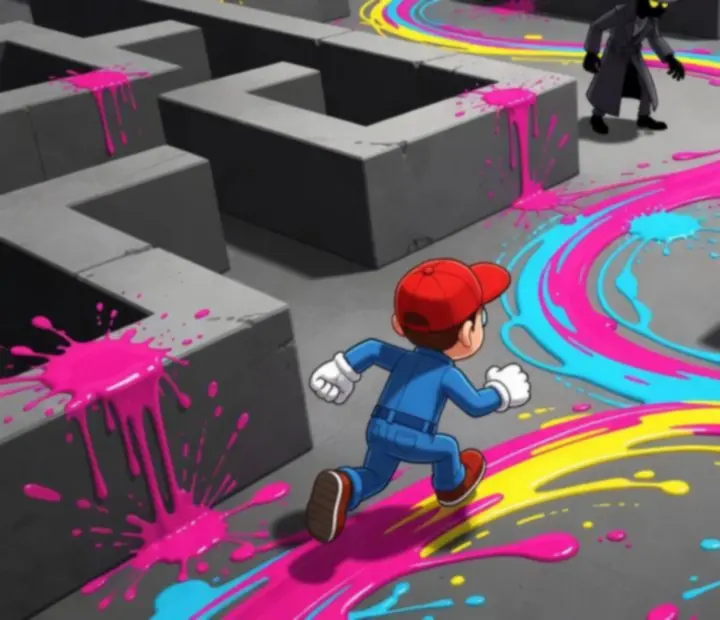
Top-down view of a Paint Hide & Seek arena showing a fake paint trail used to distract a seeker

Fake trail routes

Run a bold, obvious line toward a noisy intersection, then cut away behind cover and loop back into a quieter lane. The goal is to leave a “headline” trail that looks too easy to ignore.

  • End your fake trail near a power-up so seekers assume you grabbed it.
  • Double back through alternate corridors that stay out of their initial path.
  • Layer multiple short decoy trails near spawn to overload their choices.

Decoy movements

In team modes, assign one player as the decoy hider. Their job is to make dramatic, noisy moves through high-visibility zones, dragging seekers away from quieter teammates.

Paint ping-pong

Alternate between two nearby corridors, leaving fresh paint on each before vanishing into a third path. Seekers will waste time bouncing between the first two.

Clock Control

Timing Your Moves: When to Dash, When to Wait

Turn the round timer into a weapon. Know exactly when to freeze, when to reposition, and when to gamble on a cross-map dash.

Early game (100%–70% timer)

Seekers are still mapping lanes. Stay conservative, prioritize scouting safe loops, and avoid unnecessary paint noise around mid-map intersections.

  • Rotate slowly through the safest third of the arena.
  • Tag only essential paint trails to preserve camouflage later.
  • Do not burn key power-ups in this phase.

Mid game (70%–35% timer)

This is your reposition window. Seekers settle into patterns, so use their habits against them.

  • Dash across secondary lanes when seekers commit to far-side sweeps.
  • Relocate from over-used corners to fresh, low-paint pockets.
  • Chain short dashes with environmental sounds.

End game (35%–0% timer)

Seekers switch to aggressive clearing. Survival now depends on decisive, pre-planned routes rather than reactive hiding.

  • Commit to one survival loop with at least three backup pockets.
  • Use every remaining power-up proactively, not reactively.
  • If cornered, dash toward already-cleared zones they are less likely to recheck.

Ability Toolkit

Abilities & Power-Ups Explained

Understand every power-up in Paint Hide & Seek, from temporary invisibility to speed bursts, and how to chain them into game-winning escapes.

Invisibility burst

Best used before you are fully cornered, not after contact. Activate just before entering high-traffic intersections so seekers misjudge your chosen corridor.

  • Pair with puddle camouflage to vanish mid-splatter.
  • Never pop invisibility in straight hallways without cover.
  • Use to cross map halves, not tiny sidesteps.

Speed boost

Ideal for lane switches rather than pure outruns. Dash to the opposite side of a seeker’s sweep path, then instantly slow down to normal speed to reduce sound.

  • Use diagonally, cutting across patrol arcs.
  • Combine with fake paint trails to confuse direction.
  • Reserve at least one charge for endgame desperation.

Paint pulse / splash wave

Creates a sudden burst of color that overloads visual cues. Great for resetting your trail history and masking your final hiding pocket.

  • Trigger near intersections, then slip into side corridors.
  • Layer over older trails to erase directional clues.
  • Combo with team chat to sync multi-player misdirection.

Cooldown and combo discipline

Think of abilities as a three-step combo: information gain, reposition, and vanish. Save at least one power-up for each step instead of blowing everything on a single panic escape.

Reading the Enemy

Learning from the Seekers

Understand seeker AI patterns, how they track players, and how to exploit their line of sight in chaotic paint arenas.

Pattern recognition

Most seekers rotate between three behaviors: looping the perimeter, sweeping through mid, and checking last-seen paint trails. Watch which they default to and plan your loop in the gaps.

  • Perimeter seekers leave mid corridors under-checked.
  • Mid sweepers ignore tucked-away side pockets.
  • Trail checkers can be baited by exaggerated paint routes.

Line-of-sight traps

Seekers react strongest when they catch even a fraction of your model. Use quick peeks to pull them into inefficient chases.

  • Peek from behind cover, then retreat in a tight arc.
  • Lead seekers into corners with two escape exits for you.
  • Let them overshoot your last-known position while you loop behind.

Punish over-commitment

When seekers commit to a long hallway sprint, cut sideways through cross corridors instead of mirroring their path. Their recovery turn is your window.

Squad Stealth

Winning in Team Modes

Build cooperative strategies for team rounds, including paint communication, role assignments, and group stealth formations.

Define clear roles

Strong teams split into three archetypes: decoy, anchor, and floater.

  • Decoy: Creates loud trails and baits seekers into bad routes.
  • Anchor: Holds the safest quadrant with minimal paint noise.
  • Floater: Rotates between both, relaying seeker locations.

Paint communication

Use paint intentionally to send silent signals.

  • Double loop circles to mark “danger” zones just checked by seekers.
  • Short, straight dashes point toward safe fallback pockets.
  • Star-shaped splatters near power-ups signal “leave this for late game.”

Group stealth formations

Never stack more than two players in the same pocket. Instead, stay in a loose triangle so each player controls a different escape vector while still sharing information.

Rotate formation when seekers change patrol direction to avoid multi-tag wipes.

Download Paint Hide & Seek

Arena Progression

Adapt & React: Strategy by Level

Tailor your stealth plan to each arena layout and stage hazard so every level feels readable, not random.

Arcade-style Paint Hide & Seek arena map with suggested stealth paths and paint tactics

Early arenas: wide lanes, soft hazards

Use these maps to drill fundamentals: angle breaks, minimal paint usage, and early-game patience. Hazards are forgiving, so focus on route memorization.

  • Practice three safe loops and rotate between them each round.
  • Experiment with fake trails without fear of hard punishments.

Mid arenas: choke points and traps

Here, traps, moving hazards, and narrow bridges force commitment. Plan your power-up usage around these bottlenecks.

  • Save invisibility or speed for crossing single-lane chokers.
  • Use hazards as soft walls that redirect seeker routes.

Late arenas: layered chaos

Dense paint, vertical platforms, and multi-entry rooms demand proactive planning. Treat each room as a mini-puzzle with defined ingress and egress rules.

  • Memorize two exits for every major room.
  • Rely more on camouflage and misdirection than pure speed.
  • Track seeker AI preferences to know which layers they ignore.

Lock in your stealth toolkit before the next match.

Bookmark this strategy hub, explore our detailed guides, and keep an eye on updates as Paint Hide & Seek evolves with new arenas and balance tweaks.