From first stealth steps to leaderboard-level routes, this guide hub breaks down every tactic, arena pattern, and paint trick you need to outplay every seeker.
Move through the guides in order for a full stealth curriculum, or dive directly into the arena diagrams, mode breakdowns, and pro trick showcases that match your current skill level.
Core foundations
Stealth Mastery 101
Start here
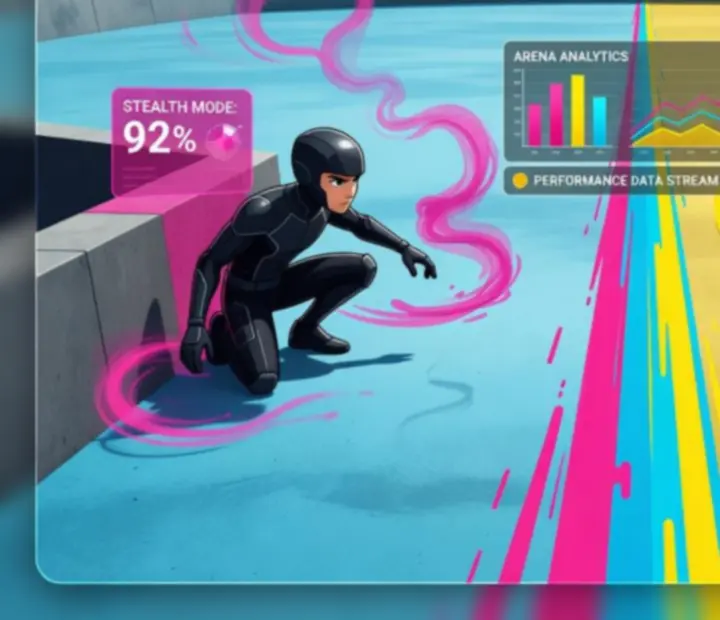
Stealth in Paint Hide & Seek is less about staying still and more about staying unreadable. Every arena tile, corner, and paint trail either hides your intent or broadcasts where you will be next.
Concealment basics
Soft cover vs. hard cover:Hard cover breaks line-of-sight completely; soft cover (like short walls or partial corners) buys milliseconds of reaction time but does not fully hide you.
Depth hiding:Stand one tile deeper than the obvious hiding spot. Seekers often pre-aim only the first layer of cover.
Angle denial:Prioritize positions where seekers must swing the camera twice to see you, such as L-shaped turns.
Movement discipline
Three-step bursts:Move in short three-tile sprints, then pause. This keeps your paint trails compact and harder to trace.
Noise windows:Time risky movements right after a seeker sprint or paint burst, when their attention is locked elsewhere.
Commit lines:Avoid long, straight corridors unless you have a pre-planned exit two corners ahead.
As you progress through the rest of these guides, keep returning to the question: “What story does my last five seconds of movement tell the seeker?” Winning runs make that story intentionally confusing.
Visual guide
Visual Guide: Maze Hideouts
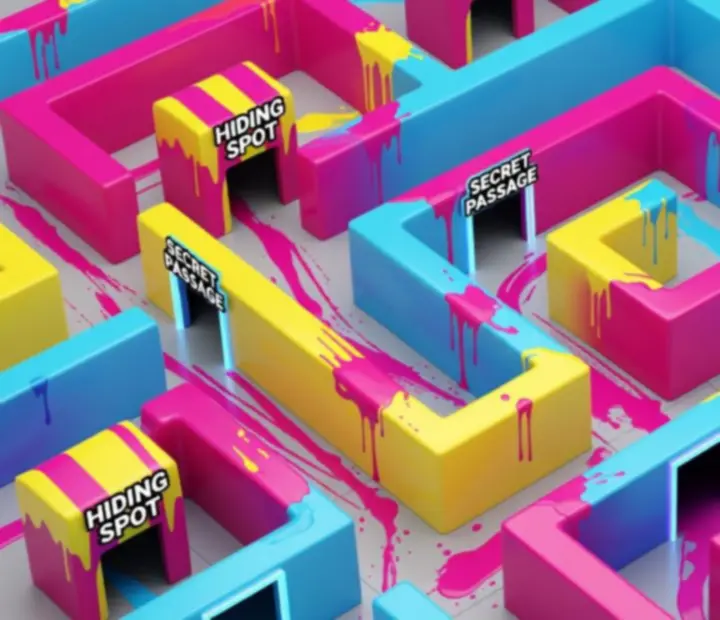
Arena diagramsKey hideouts are marked in cyan, while emergency escape tunnels glow in magenta. Use both to stagger your retreat path.
Classic hideout archetypes
Forked corners:Two exits form a Y-shape. Enter from one branch, exit through the other while the seeker checks the stem.
Dead-end feints:Leave a partial paint trail into a dead end, then wall-hop around it using a nearby side corridor.
Shadow alleys:Dimly lit corridors near arena edges where paint contrast is low. Great for low-ink routes.
Designing your rotation
Triangle loop:Chain three hideouts into a repeating triangle. It is small enough to memorize but varied enough to stay unpredictable.
Escape anchors:For every hideout you use, memorize one “panic door” that always leads away from typical seeker patrols.
Line-of-sight resets:Cross at least two corners between you and the last known seeker position before settling in a new hideout.
Practice each arena offline by walking slow laps and marking three “safe triangles.” When a chase begins, your goal is simply to move from triangle to triangle, not to improvise on the spot.
Paint trail tactics
The Art of Paint Splattering
Cover & decoyIntentional splatters can disguise your true route, forcing seekers to chase ghosts instead of your avatar.
Paint as camouflage
Zone flooding:Overpaint a small section of the arena until every tile is covered. Your last footsteps become impossible to separate from older splashes.
Color confusion:Overlap your own trails to blur directional arrows. Broken, dotted patterns are easier to read than dense clouds.
Shadow splatter:Use darker corners where paint is less saturated visually, limiting how much information seekers get from your passes.
Paint as a decoy
False exits:Paint strongly toward one corridor, then double back through a side gap, leaving the main trail unfinished.
Loopback halo:Create a circular trail that returns near its starting point, then slip away quietly while seekers chase the loop.
Partner confusion:In co-op runs, purposefully cross trails with teammates to obscure which hider is which.
Review your replays and screenshot sections where your trails feel “noisy.” Those zones are perfect for planting future decoy splatters that look believable but lead nowhere.
Seeker behavior
Enemy AI Patterns Explained
Patrol logic
Seekers in Paint Hide & Seek feel unpredictable, but they follow timing rules and reaction priorities that you can learn, exploit, and even bait for stylish escapes.
Core AI behaviors
Patrol loops:Each seeker favors a repeating three- to five-corner patrol route. Watch the pattern for two full cycles before cutting across it.
Fresh paint priority:AI ranks new paint higher than old. Recent, bright splashes increase the chance of a patrol detour.
Line-of-sight bursts:When you briefly cross a seeker’s vision, expect a short speed burst plus a narrow cone scan in the same direction.
Alert phases & response times
Curious phase:A quick camera tilt toward noise or fresh paint within one second. No full chase yet; this is your window to sidestep.
Chase phase:Lasts three to five seconds depending on game mode. During this time, seekers ignore most other distractions.
Reset phase:After losing sight, seekers slow down and return to patrol. Use this moment to rotate to a distant triangle of hideouts.
Force seekers into chase phase on your terms by flashing across a known patrol at a safe distance, then kiting them into zones where you have multiple escape exits prepared.
Character loadouts
Choosing Your Avatar
Playstyle fit
Each avatar in Paint Hide & Seek subtly shifts your stealth rhythm: some reward aggressive paint usage, others favor silent glides and late chases. Matching avatar to mindset is more important than raw stats.
Avatar type
Strengths
Best for
Speedster
High sprint burst, excells at last-second escapes
Players who enjoy reactive, chase-heavy runs
Shadow Walker
Low noise footprint, reduced paint density
Methodical hiders who win via pure positioning
Tracer
Extra vivid paint, ideal for baiting AI routes
Players who like trap-setting and misdirection
Experiment with each avatar for at least five full matches in a single arena. Track which one feels natural when you are under pressure; that is the avatar that will carry you through advanced modes.
Mode breakdown
Top 5 Winning Game Modes
Mode metaEach mode tweaks timer pressure, seeker behavior, and paint economy. Your tactics should shift to match.
Classic Hunt:Balanced timers and predictable patrol loops. Focus on learning triangle rotations and paint economy.
Time Trial Survival:Accelerating difficulty over time. Play conservatively early, then switch to aggressive misdirection once seekers get faster.
Ink Limited:Restricted paint supply. Prioritize soft cover and low-noise avatars; every splatter must mean something.
Fog of Paint:Reduced visibility with heightened color contrast. Use sudden color pops to fake direction changes.
Co-op Chaos:Multiple hiders and shared paint fields. Coordinate routes so teammates feed into your prepared decoys.
Specialize in one or two modes to climb leaderboards faster. Once your fundamentals are stable, expand to others using the same rotation logic and paint principles.
Reading the map
Color Coded Tactics: Painted Clues
Trail reading
Every streak of color on the floor is a timestamp and a direction arrow. Reading these clues faster than the seeker turns the entire arena into your minimap.
Decoding the arena
Brightness as age:Fresh paint looks vivid; older splashes desaturate. Assume highly saturated lines are under fifteen seconds old.
Breaks in the trail:Gaps often mark sudden turns, jumps, or evasive moves. Use them to predict pivot corners.
Clumped splatter:Heavy splashes near corners signal panic turns or choke points where many players collided.
Writing misleading clues
Mirrored routes:Run a path, then retrace part of it in reverse to make direction ambiguous.
False freshness:Lightly repaint older trails with short taps to make them look recent without fully committing your route.
Color storms:In multi-color modes, cross your own lines repeatedly so they blend into a chaotic storm that reveals nothing.
Progression paths
Level-Up Progression Paths
Growth plan
Climbing through Paint Hide & Seek’s challenges is smoother when you treat your progress as a build: specific arenas, power-ups, and modes combine into a clear growth path.
Phase 1 – Fundamentals:Grind Classic Hunt on the smallest arenas using Stealth Mastery 101 concepts until escapes feel automatic.
Phase 2 – Paint control:Switch to Ink Limited. Focus on conserving splatter and using color-coded tactics for information.
Phase 3 – Pressure handling:Move into Time Trial Survival to practice late-game rotations where seekers are fastest.
Phase 4 – Arena expansion:Unlock new arenas and map at least two safe triangles of hideouts on each before playing ranked-style runs.
Phase 5 – Pro refinement:Apply Pro Trick Showcase techniques to fine-tune your route timing and paint feints in your favorite modes.
Revisit earlier phases whenever you unlock a new avatar or arena. The same foundations will feel fresh and open up new trick routes.
Survival focus
Time Trial Survival Tips
Advanced
Time Trial turns every misstep into a lost second. Your goal is not just to survive, but to survive cleanly: no wasted movement, no reckless chases, no unreadable routes for yourself.
Route planning
Segment your run:Divide the timer into three segments and assign a specific arena quadrant to each. Rotate quadrants instead of improvising.
Risk layering:Start with low-risk triangles, then gradually incorporate riskier shortcuts as seekers accelerate.
Checkpoint corners:Mark a few “reset corners” where you know multiple safe exits exist. Return to them whenever a chase becomes messy.
Risk management
Chase cap:Limit yourself to one intentional chase every thirty seconds to avoid snowballing panic routes.
Paint budget:Reserve a portion of your paint for emergency decoys in the final quarter of the timer.
Abort conditions:If you hit two dead ends in under ten seconds, immediately rotate to a different quadrant to reset pressure.
Decision-making
Infographic: Stealth vs. Speed
BalanceDifferent situations demand different mixes of hiding and sprinting. Use this mental chart to choose the right response.
The strongest players treat stealth and speed like a slider, not a switch. Every encounter is a chance to nudge that slider based on distance, cover, and seeker alert state.
When to favor stealth
Seeker is off-screen and paint trails are dense.
Timers still show plenty of time remaining.
You are near high-value hideouts or triangle rotations.
When to favor speed
Seeker is locked onto another player or decoy trail.
Timer is low and you must cross exposed ground.
Your current zone is “paint solved” and no longer safe.
Imagine a dial in your mind that you twist between stealth and speed every five seconds. Consciously updating that dial keeps you from defaulting into one extreme playstyle.
FAQ
FAQ: Common Player Mistakes
Fix fast
Why do I keep getting trapped in corners?
You probably enter corners without a mapped exit. Before diving into any nook, mentally label at least one safe path that gets you two corners away if a seeker appears.
Am I using too much paint?
If you can track your last thirty seconds of movement by looking at the floor, you are over-painting. Aim to leave sections of your path deliberately blank so seekers cannot reconstruct your whole run.
How do I stop panic sprinting?
Set a rule: after every three-second chase, force yourself to pause for half a second in cover. This break lets you reset your route instead of running blindly.
Why do I lose track of seekers?
Train yourself to glance at mini-maps and audio cues on a rhythm—every four steps, quickly scan. The more consistent that rhythm, the less likely you are to be surprised.
High-level play
Pro Trick Showcase
Expert moves
These are advanced patterns you will see from top scorers in Paint Hide & Seek. Practice them slowly in solo runs before attempting them in high-stakes matches.
Signature maneuvers
Ghost swap:Dash past a seeker at the exact moment they burst toward a decoy trail behind you, effectively trading positions without a chase.
Paint curtain:Flood a narrow corridor with overlapping splashes, then blend into a side pocket as seekers follow the center line.
Corner echo:Tap paint quickly on a corner, step back, then move only after the seeker rushes past your last splatter.
Training drills
Run five laps around a single triangle of hideouts without leaving extra paint in the same lanes.
Practice deliberately losing line-of-sight, counting the seconds between losing view and AI reset.
Record a short session and trace your path with your finger; if it looks obvious, redesign your rotations.
Combine one or two of these tricks with solid fundamentals instead of chasing flashy plays every match. Consistency beats highlight reels on long ladder climbs.